




11 August 2026
|
8:10:45
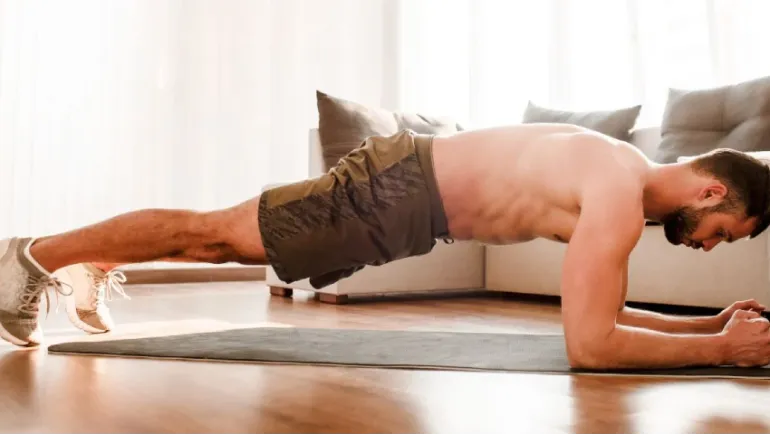
Gym membership is not a prerequisite for meaningful fitness progress. The most effective home workouts in 2026 leverage bodyweight your own body as resistance combined with consistency and progressive challenge. For Bangladeshis navigating urban apartment living, budget constraints, or time limitations that make gym attendance impractical, home workout plans offer a genuinely effective path to improved strength, cardiovascular fitness, and physical wellbeing without any equipment investment.
The science behind bodyweight training is well-established. Push-ups, squats, lunges, planks, and their progressions engage multiple muscle groups simultaneously, build functional strength that transfers directly to everyday movement quality, and can be progressively scaled to match any fitness level from complete beginner to advanced athlete.
Unlike machine-based gym training that isolates individual muscles, bodyweight training trains movement patterns developing balance, coordination, and joint stability alongside raw strength. This functional quality makes it arguably more practically beneficial than equivalent machine-based training for most non-athletes.
Begin with a 5-minute warm-up of arm circles, shoulder rolls, and light jumping jacks to prepare joints and elevate heart rate.
The main circuit combines push-up variations, plank holds, tricep dips (using a chair), mountain climbers, and Superman back extensions. Perform each exercise for 40 seconds of effort followed by 20 seconds of rest. Complete 3 full rounds of the circuit, resting 60 seconds between rounds. Finish with 5 minutes of upper body stretching targeting chest, shoulders, and triceps.
Warm up with 5 minutes of marching in place, leg swings, and hip circles. The main circuit includes bodyweight squats, reverse lunges, glute bridges, calf raises, and lateral shuffles. The same 40-on/20-off timing applies, for 3 rounds.
Finish with 5 minutes of lower body stretching hip flexors, hamstrings, and quadriceps with particular attention to hip flexors if you spend significant time sitting.
A shorter, higher-intensity session combining burpees (modified for beginners with no jump), squat thrusts, high knees, and plank variations into a continuous circuit that elevates heart rate and challenges the full body simultaneously.
Light walking, gentle yoga stretching, or simply moving throughout the day without structured exercise. Recovery is as important as the training sessions themselves this is where physical adaptation and strength improvement actually occur.
The key to continued progress in bodyweight training is progressive overload making exercises gradually more challenging as your fitness improves. This is achieved without equipment through increasing repetitions, slowing down the movement for greater time under tension, reducing rest periods, adding movement complexity (standard push-up to decline push-up to single-arm progression), and improving range of motion.
Track your performance each session reps completed, circuit rounds finished, or how a specific exercise feels to monitor progress and inform when to advance the difficulty.
Every exercise in the above plan has a beginner modification that makes it accessible regardless of current fitness level. Push-ups can be performed from the knees. Squats can be limited to a partial range of motion. Burpees can remove the jump entirely. These modifications allow beginners to build strength and movement patterns safely before progressing to full versions.
The goal in the first four weeks is not maximum intensity it is consistent, quality movement that builds the habit and the physical foundation for progressive improvement.
The primary challenge of home workout plans is not the exercises it is the environment. Home contains competing demands, comfortable furniture, and none of the social accountability that makes gym attendance feel obligatory.
Schedule your home workouts as fixed daily appointments. Designate a specific space in your home as your exercise area, even if it is simply a cleared section of the bedroom floor. Begin with 20-minute sessions if 30 minutes feels daunting starting and completing a shorter workout consistently outperforms occasionally doing a perfect longer session. The habit, built over six to eight weeks, becomes self-sustaining.












Comments
There are no comments for this Article.